Exhibitions and Sculptures
  |
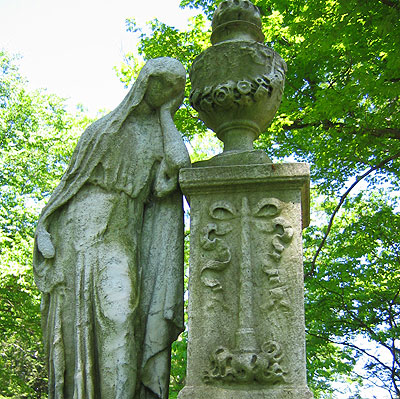
JOHN R. ROBBINS MONUMENT Who was John R. Robbins? Boston city directories indicate that in the nineteenth century, Robbins owned and operated a “bowling saloon” on Washington and Sudbury Streets. Robbins probably bought the lot at Forest Hills when his first wife died; two children who had died several years before were moved to Forest Hills at that time. Robbins buried quite a few of his family members, including his second wife and a 15-year old son. He died in 1897 at the age of 84, of what was called “exhaustion.” This monument, like the Sumner monument, was likely another off-the-shelf piece imported from Italy, although we can’t be certain. Books full of possible monument designs were available to clients, who like today could choose something they liked or felt was appropriate. The motifs Mr. Robbins chose would have been very familiar from the study of classical civilization, literature and mythology, which was an important part of one’s formal education. The figure of the mourning or weeping woman, dressed in Greek-style robes, is an allegorical figure, that is, an embodiment of an abstract concept. Allegorical figures have been classified in books for architects and architects, along with their “attributes,” or symbols, since at least the Renaissance; allegorical figures show up all over the Cemetery. This particular mourning figure is known as “Grief.” Grief always leans next to or near a funerary urn. The funerary urn is another reference to classical Greece, where urns held the ashes of the deceased. Versions of Grief were extremely popular in the American Early Republic period (1780-1830), when they were reproduced as tabletop ceramics, or by young girls in needlework pictures, especially when someone famous died, like George Washington. When Mr. Robbins chose this monument, Grief and her urn was a well-known mourning image in nineteenth century popular culture. Notice also other elements that you will see repeated elsewhere at Forest Hills, including the inverted torch that indicates the “snuffing out” of life, and the flame at the top of the urn, which refers to eternal life or resurrection. The winged hourglass refers to the passage of time. Robbins also wanted to make sure that people knew he and his family were familiar with the Bible; the Biblical inscription “I am the Resurrection and the Life” on the front is the same as that on the Cemetery entrance gates. This monument was considered very fashionable in its early days; an engraving of it was included in the 1858 guidebook of Forest Hills showing notable or beautiful monuments. While at the Robbins Monument, take a moment to consider the Randidge Monument.
|
[FHET
HOME] [ABOUT FOREST HILLS] [EXHIBITIONS
& SCULPTURE] [CALENDAR OF EVENTS]
[EDUCATION & PRESERVATION] [CONTACT
US] [DIRECTIONS & HOURS]